

But as interest in AI accelerates, one question remains top of mind for leaders and clients alike: How do you innovate with AI responsibly, for the right reasons, without introducing risk to operations, data or homeowner trust?
At Cenlar, the answer starts with discipline.
The Cenlar AI Lab is a dedicated environment where we explore how artificial intelligence can meaningfully enhance mortgage servicing for clients and homeowners, long before those ideas ever touch live operations.
Designed as a secure, nonproduction innovation sandbox, the Lab allows Cenlar teams to test, learn and demonstrate AI-powered solutions in a controlled setting that prioritizes governance, oversight and accountability.
Importantly, this is done with the whole organization in mind. Our employees are part of the process and encouraged to consider how AI may assist them in their role. We emphasize value first (to clients and homeowners), learning second and scale only when the outcome is clear within appropriate guardrails.
A Safer Way to Innovate
The AI Lab was built to address a simple but critical challenge: moving quickly with AI while protecting the integrity of servicing operations.
Within the Lab, our team experiments with emerging capabilities such as intelligent reporting, document processing, workflow automation and conversational tools, without exposing customer data or production systems. This non production approach allows Cenlar to move from idea to insight faster, while maintaining the trust that clients and homeowners expect.
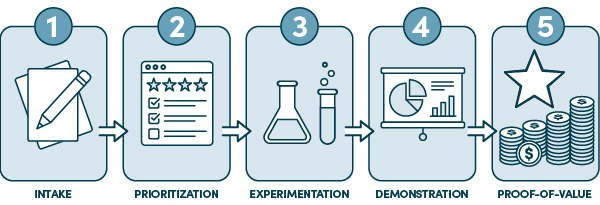
Just as importantly, the Lab provides structure. Experiments are not one-off tests or technology demos; they follow a repeatable life cycle that includes intake, prioritization, experimentation, demonstration and proof-of-value. That structure ensures that innovation remains purposeful, measurable and aligned to real needs.
One of the most important roles of the AI Lab is helping Cenlar validate business value early.
Before investing in full-scale deployment, teams use the Lab to answer essential questions: Does this capability improve efficiency? Does it enhance accuracy or insight? Does it meaningfully support the client or homeowner experience?
For example, a daily challenge in subservicing is supporting clients and their homeowners to the unique specifications of each individual client. If you have 100 clients, there are also 100 different versions of terms, procedures and obligations. In an experiment with a Client Overlay Copilot, we created one searchable catalog of client contracts that included all the unique clauses and standard operating procedures our teams must reconcile on a daily basis.
We observed a 70% reduction in the time it takes to search policies, significantly lowering manual reconciliation work. Leveraging AI, we could review contracts in seconds, instead of the 15 minutes it takes to review manually. It enabled us to process more than 200 documents in less than 3 minutes, compared to weeks of manual work. Errors decreased, while compliance grew stronger. It allowed us to update procedures and controls more rapidly following changes in agreement. And it provided a reliable, easy-to-use source of client-specific needs, allowing our team to provide a consistent experience at every interaction point.
It also revealed obstacles and roadblocks that would have hampered our operations if we had attempted to put the idea straight into action. Instead, we have taken what we learned and now are using it to inform how we move forward.
Learning as a Strategic Advantage
The AI Lab serves another essential purpose: building AI fluency across the organization.
We encourage our employees to consider what they routinely experience in their jobs and how AI might help them. In less than a year, employees have brought forth 20 suggestions for application development directly tied to their roles that are now being explored.
They are use cases like complaint trending and intelligence, AI forecasting for call center staffing, a smart agent for Enterprise Change Management intake and default management reporting automation.
This all-hands-on-deck mindset is at the heart of the experimentation being conducted in the Lab. Default Management Reporting Automation, for example, is a suggestion that came from the business area and now has modernized a previously manual reporting process using AI and automation. We are at the end of the experimentation phase on this enhancement and are near implementing it in the live environment.
Hands on experimentation gives teams exposure to real use cases, best practices and emerging technologies. Documentation, demos and clear decision points turn experimentation into shared understanding, ensuring that knowledge doesn’t live with a single team or vendor but becomes part of our broader capability.
This learning-focused mindset is especially important as AI continues to evolve. By investing in understanding, not just tools, Cenlar positions itself to adapt as technology changes, rather than chasing trends.
A Bridge Between Innovation and Execution
Ultimately, the Cenlar AI Lab acts as a bridge between innovation and execution. It enables the company to explore what’s possible, demonstrate tangible outcomes and make informed decisions about where AI can deliver meaningful impact, without compromising trust, compliance or operational excellence.
Cenlar’s approach to responsible innovation isn’t about slowing down. It’s about building the right foundation so progress lasts.