

For homeowners, it represents a financial achievement, the closing of an important chapter. For mortgage servicers, loan payoff is one final chance to deliver a seamless homeowner experience.
At Cenlar, we believe homeowner satisfaction is driven by simplicity and clarity.
Knowing this, over the last year, our payoffs team at Cenlar tackled an important question: How can you improve speed and efficiency while maintaining accuracy, compliance and high-quality service?
By following the credo “observe and dig in,” our team used its expertise to question the status quo. Its answer was not simply more automation. It was smarter automation informed by operational expertise. And it’s delivered astounding results.
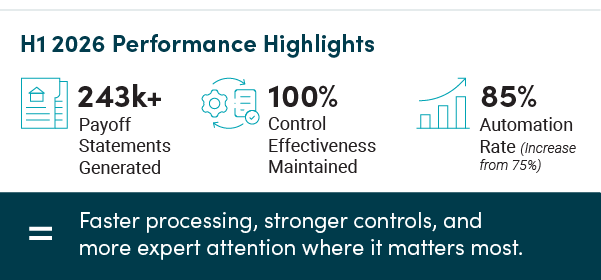
In the first half of 2026, the team generated more than 243,000 payoff statements while maintaining 100% control effectiveness. During the same period, the organization increased payoff automation rates from 75% to 85%, allowing more transactions to move quickly through the process. It left our experts able to focus on complex scenarios that actually required specialized attention.
Looking Beyond the Majority
Good innovation often starts by focusing on what’s not working.
Rather than accepting that a portion of payoff requests would always require manual processing, our team took a closer look at the exceptions that couldn’t be automated. By examining rejection criteria and identifying process bottlenecks, they uncovered opportunities to streamline and improve the overall experience.
The resulting enhancements addressed a range of operational challenges, including removing lapsed prepayment penalty conditions and anticipating force-placed insurance scenarios and other exceptions that historically required multiple handoffs and manual intervention. Allowing use of electronic signatures in scenarios they previously hadn’t further reduced friction for homeowners and clients.
The lesson is an important one for mortgage servicing organizations: by understanding where processes break down, servicers can improve efficiency, the homeowner experience and client satisfaction.
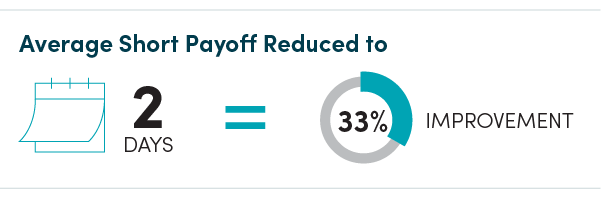
A perfect example is the handling of short payoffs, which can create delays and additional communication when funds received do not fully satisfy the payoff amount. Through more proactive management and enhanced homeowner outreach utilizing our experienced call center advisors, Cenlar reduced average short payoff resolution times to two days, a 33% improvement. Teams also implemented improved tracking and communication processes that allowed greater clarity and insight into the results of our outreach efforts, allowing us to finetune in real time.
Scaling While Volumes Grow
Operational excellence becomes even more important during periods of increasing demand.
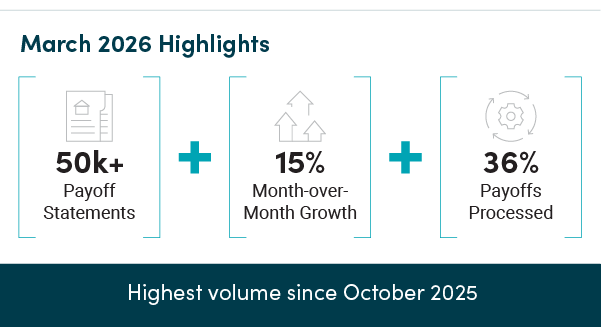
In March 2026, Cenlar generated more than 50,000 payoff statements, representing a 15% month-over-month increase and the highest volume since October 2025. At the same time, the organization processed 36% more payoffs than it did in February.
These results reinforce a challenge facing mortgage servicers across the industry: how to continue delivering high-quality experiences amid high homeowner expectations and fluctuating conditions.
The answer lies in building intelligent processes that can scale efficiently while maintaining strong controls and service levels. By combining automation with operational expertise, Cenlar created capacity where it matters most. Routine activities can move more efficiently through automated workflows, allowing employees to dedicate more attention to complex borrower situations that require judgment, empathy and problem-solving.
A Blueprint for the Future
Artificial intelligence, automation and digital servicing tools continue to reshape mortgage operations. Yet the Cenlar payoff team's experience highlights a reality often overlooked in discussions about innovation.
Technology delivers its greatest value when paired with people who understand the work deeply enough to improve it.
At Cenlar, we believe the future of servicing belongs to organizations that successfully blend advanced technology with operational expertise. Those organizations will continuously question assumptions, refine experiences and find new ways to make complex moments simpler for homeowners.
Sometimes innovation is not about building something entirely new. Sometimes it is about taking a closer look at what exists, understanding where friction happens and empowering talented teams to solve it.